Stewardship Over Speed: Designing for Continuity
Why most ideas fade quietly and what it looks like to design for alignment before acceleration.

Most ideas don’t die in public. They don’t collapse after a dramatic launch, implode after investor backlash, or fail in headlines. They disappear quietly, as if they never existed in the first place. A designer sketches something promising. A friend says, “You should really build that.” A Google Doc fills with early thoughts. There’s a flurry of texts. A shared folder is created. A domain is purchased. And then nothing.
Not because the idea was weak, or the people weren’t talented, but because the space between inspiration and infrastructure is unforgiving.
Imagine a small project, call it a community-based mental health collective. A therapist wants to build a peer-supported network outside traditional insurance systems. She has clarity of purpose but no technical team. A friend offers to help with branding. Someone else says they know a developer. They meet twice. Energy is high. But then questions surface.
Who owns this?
If it works, who decides direction?
What happens if someone contributes 200 hours and someone else contributes 20?
Is this a nonprofit? A startup? A side project?
No one wants to talk about equity yet; it feels premature. No one wants hierarchy; it feels wrong. But without structure, contribution becomes ambiguous. It isn’t just awkwardness that stalls these conversations. There is rarely a clear vehicle for handling contribution and ownership fairly without already having legal structure in place. Momentum thins. The idea begins to feel heavier than it did at the beginning. Within three months, it’s dormant. Not because it lacked value, but because it lacked alignment. That pattern repeats quietly across industries and ambitions.
This is the terrain Heirloom was built to address. At its most literal level, Heirloom describes itself as a collaboration operating system for early-stage teams to stay aligned, track and reward contributions, and keep momentum. That definition is functional. Accurate. Clean.
But it doesn’t yet explain why something like this would need to exist. The deeper issue isn’t that people lack tools; there are plenty of tools. Project management software. Messaging platforms. Cofounder matching sites. Accelerators. Incubators. Even Y Combinator, in its way, exists to help ideas cross the early threshold from concept to company. But most of those systems assume something critical: that you already have a team, a legal structure, a defined cap table, or at least a shared understanding of who owns what. They operate after alignment. And when alignment is assumed rather than structured, strangers are left to negotiate fairness on their own. That negotiation is often where things begin to fracture.
Heirloom is concerned with what happens before.
Before the LLC.
Before the accelerator application.
Before the pitch deck.
Before the moment when someone says, “Okay, this is real.”
It is concerned with the fragile period where ideas are still forming, where contributors are still strangers, and where fairness is often deferred because it feels awkward to address too early. And that is where most ideas fail; not in the market, but in the ambiguity.
Heirloom did not begin as a feature set. It began as repetition. The same conversation kept surfacing; a friend talking about leaving their job but unsure how to build something sustainable; a parent considering starting a private practice but overwhelmed by logistics. A peer with a promising idea who could not find the right people to help move it forward. Different circumstances. Same sentence beneath them.
“I want to work on something I care about, but I don’t have the support to figure it out alone.”
That sentence is where many ideas begin to thin. Not because desire is absent, but because structure is. For Brandon, founder of Heirloom, that repetition eventually stopped feeling anecdotal and started feeling structural. “I kept seeing the same patterns repeat themselves over and over again,” he told me. “Every time someone talked about wanting to pursue something they were passionate about, the barrier wasn’t ambition. It was infrastructure.”
At the same time, the broader landscape of work was shifting. The modern labor movement was gaining momentum. Workers were organizing, reassessing employment conditions, questioning long-standing assumptions about loyalty and compensation. Layoffs were no longer rare events but recurring headlines. More people were asking not just how to earn, but how to build.
Those forces converged into a question that would not leave him alone: What would it take to increase real opportunity for people who wanted to create something of their own? Entrepreneurship, for all its mythology, is not evenly accessible. It often requires privilege: time, financial cushion, legal guidance, access to networks. Yet the interest in building was clearly growing. The problem was not a lack of ideas. It was that most ideas died before they ever formed teams.
Heirloom’s Root Problem: Alignment Before Scale
Brandon had experienced versions of this himself. Cofounder disagreements around equity that derailed momentum. The exhaustion of balancing passion with existing responsibilities. The transactional nature of freelance work that could complete tasks but rarely built shared commitment. Connection platforms that helped people meet but offered no structure to collaborate fairly once they did.
“It wasn’t that people didn’t want to build together,” he said. “It’s that there wasn’t a strong base for doing it.” That distinction matters. It reframes the issue from personality conflict to system design.
Around this time, Brandon began diving deeply into employee ownership research. Shared Capitalism at Work. The Citizen’s Share. Research from institutions like the Rutgers Institute for the Study of Employee Ownership, which has spent decades examining how employee ownership reshapes incentive structures inside firms. What started as curiosity became conviction.
If traditional employee ownership could realign incentives within mature organizations, could a version of that logic help early-stage teams align before conflict took root? This is where dynamic equity entered the picture. Not as a buzzword, but as a vehicle.
- A way to track contribution over time.
- A way to reward effort proportionally.
- A way to reduce the pressure of making permanent ownership decisions before trust had formed.
“I often joke that if Heirloom existed right now, building Heirloom would be a lot easier,” he said. The humor in that sentence carries weight. It suggests that Heirloom is not merely a platform for others. It is an attempt to solve the very problem that made building it difficult in the first place.
Why “Heirloom”
Names are often chosen for aesthetics. Heirloom was chosen for responsibility. The word surfaced during a period when the concept was still fluid. Early iterations carried different energy. Prometheus. Hyve. Ember. Village. Each reflected a facet of the problem.
An heirloom is not just valuable. It is entrusted. It is something preserved across time, passed down not because it maximizes returns, but because it holds meaning. In traditional employee ownership models, particularly ESOPs, companies themselves often become heirlooms. Founders pass businesses to their workers as a succession strategy. Ownership becomes continuity rather than exit. Heirloom extends that logic backward in time.
Instead of asking how to transfer a mature company responsibly, it asks how to build early ideas responsibly before maturity is even possible. “The name comes from the idea of family heirlooms,” Brandon explained. “An idea is something that’s precious to you. It’s something you want to pass down.”
On the platform, organizations are called Looms. The metaphor is not ornamental. A loom is a tool for weaving separate threads into something cohesive. In traditional organizations, idea-sharing is often hierarchical. Initiative flows through permission structures. Contribution is measured in roles rather than momentum. Heirloom attempts to invert that pattern.
Within a Loom, idea contribution is intentionally low-stakes. Members are encouraged to propose, refine, and build collectively without needing to secure authority first. Collaboration is not an add-on feature; it is the fabric.
Bamboo, Not Fireworks
The temptation in early-stage building is acceleration. Launch fast. Gain traction. Raise capital. Scale. Repeat. The ecosystem rewards visible momentum. Growth charts. Headlines. Funding rounds. The mythology of startups has trained builders to equate speed with seriousness. If something is not moving quickly, it is assumed to be failing.
Heirloom was built in tension with that instinct. From the beginning, there were adjacent problems that could have been solved more quickly. Simplify the concept. Remove the complexity of shared ownership. Focus on a narrower feature set. Monetize sooner. Build something easier to explain. Each of those moves would have reduced friction, but would have also reduced the ambition of the system.
“The biggest tradeoff I made was committing to creating value before trying to sell that value,” Brandon told me. “A lot of startups flip that. They sell first and then figure it out later. I didn’t want to do that.”
Brandon describes building a startup as being like growing bamboo. For a long time, bamboo develops underground. There is no visible progress. From the surface, it appears static. Then, suddenly, it breaks through and grows rapidly. The early work was not wasted; it was structural.
“Heirloom has been a long and slow process,” he said. “We’re constantly iterating and trying to find our fit. But I like to think of it like bamboo. You’re growing something underground long before anyone sees it.”
A Fair Beginning
Let’s return to the therapist with the idea for a community-based mental health collective. In the earlier version of her story, momentum thinned. Equity felt premature. Ownership felt awkward. The idea became heavier than the people carrying it.
Now imagine a different version.
She posts the concept inside a Loom. The branding friend joins. The developer joins. They begin contributing in visible ways. Hours are tracked. Contributions are recorded. Ideas are proposed without needing permission from a formal hierarchy.
Instead of deferring ownership conversations indefinitely, there is a mechanism for acknowledging effort proportionally as it unfolds. No one has to guess whether their work matters. No one has to silently calculate whether they are giving more than they are receiving. The structure absorbs some of that ambiguity before it becomes conflict.
The collective may still fail. Not every idea survives. But it will not fail because contribution was invisible or ownership was deferred until resentment set in. It will not dissolve because the founders were afraid to talk about alignment.
Heirloom does not guarantee success. It does not remove the difficulty of building something meaningful. It does not eliminate market realities or human disagreement. What it attempts to do is simpler and, in some ways, more radical: it attempts to give ideas a fair beginning.
If it works, the outcome will not be measured only in growth curves or funding announcements. It will be measured in the absence of a certain kind of regret. Fewer people saying they let something meaningful go because the path forward was too unclear to navigate alone.
In that sense, Heirloom is less about startups than about continuity. An heirloom is preserved so that something valuable is not lost between generations. Heirloom applies that same instinct to ideas. Not all of them will become companies and not all of them should. But fewer of them will disappear quietly. And that, for now, is enough.
Whether Heirloom succeeds is still an open question. Most early-stage platforms face uncertainty, and this one is no exception. But the problem it addresses is not speculative. Ideas will continue to emerge faster than our systems are prepared to support them. Every week, someone begins sketching something they care about. A document opens. A message is sent. A conversation starts. Most of those beginnings never mature into structure. That is not always a failure of imagination. Often, it is a failure of infrastructure.
Heirloom is one attempt to close that gap. Not by accelerating ambition, but by stabilizing it. Not by promising outcomes, but by protecting beginnings. If more ideas survive their fragile stage, the effect will not be dramatic. There will be no single headline that captures it. There will simply be fewer quiet endings. And fewer quiet endings, over time, change the shape of opportunity. Especially for those who inherit it.
Written by Soren Kai
Guest contributor and early Heirloom user. More writing at Soren’s website.
More to explore
Keep reading to go deeper on shared ownership and collaborative building.

Heirloom Originals: Open Projects & How to Join
Jump into a Loom, meet collaborators, and start shipping together.
Read article
The Future of Work: How Heirloom is Shaping Collaboration
Drawing from research and personal experience, here's why I believe co-ownership can change how we build.
Read article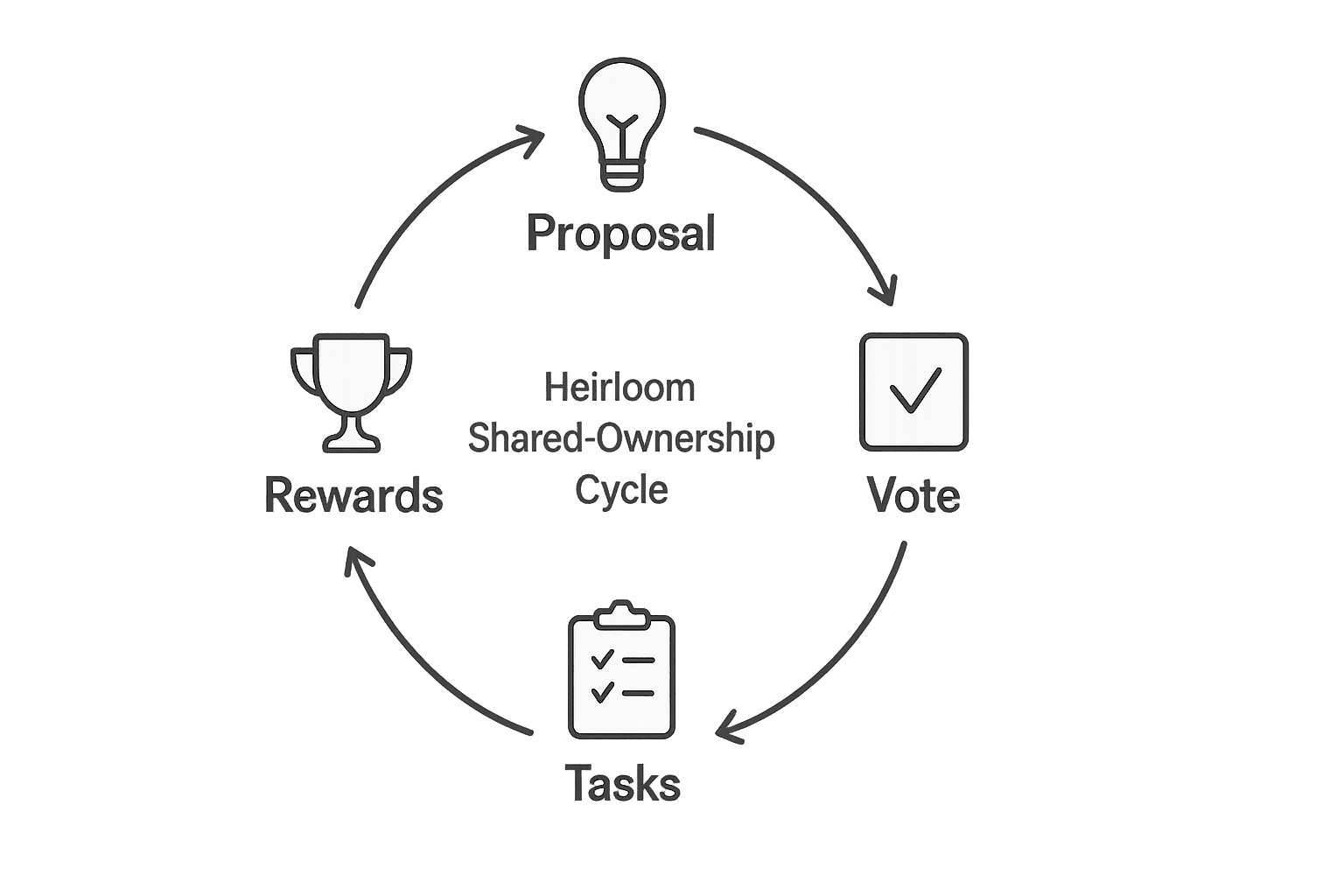
Choose Together, Build Together: How Heirloom’s Shared-Ownership Cycle Works
Drawing from research and personal experience, here's why I believe co-ownership can change how we build.
Read articleCollaborate with brilliant builders.
Own what you ship.
Add your project to Heirloom or join an existing team. Share what you're building, find collaborators, and keep ownership fair with dynamic equity.
Free to start • No cohort required • Keep your idea alive in public